INDICATIONS

PAVBLU® (aflibercept-ayyh) is indicated for the treatment of Neovascular (Wet) Age-Related Macular Degeneration (AMD), Macular
Edema following Retinal Vein Occlusion (RVO), Diabetic Macular Edema (DME), and Diabetic Retinopathy (DR).

PAVBLU® is not indicated for Retinopathy of Prematurity, for which Regeneron has marketing exclusivity.

PAVBLU® (aflibercept-ayyh) is indicated for the treatment of Neovascular (Wet) Age-Related Macular Degeneration...Read more

PAVBLU® (aflibercept-ayyh) is indicated for the treatment of Neovascular (Wet) Age-Related Macular Degeneration (AMD), Macular
Edema following Retinal Vein Occlusion (RVO), Diabetic Macular Edema (DME), and Diabetic Retinopathy (DR)...Read more


FDA requires rigorous evaluation
of biosimilars1

Biosimilars are proven to be highly similar to their reference product, with no clinically meaningful differences in safety or efficacy2

AS MANY AS ~ 100 DIFFERENT DRUG ATTRIBUTES
ACROSS ~ 40 ANALYTICAL METHODS

ARE MEASURED TO ESTABLISH SIMILARITY3

Biosimilars are analyzed and carefully compared to the reference product using a number of characteristics called critical quality attributes (CQAs), which are features associated with the reference drug that can impact safety, potency, pharmacokinetics, and overall quality.4

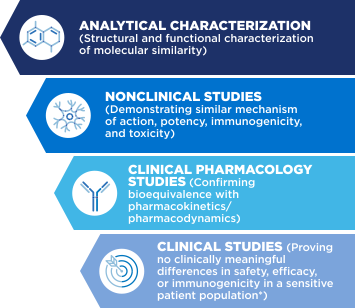
Approval of a biosimilar is based on the totality of evidence generated using a stepwise approach to demonstrate biosimilarity1

Extrapolation is used to support the approval of a proposed biosimilar product in one or more additional indications for which the reference product is licensed, but for which the biosimilar has not been studied in clinical trials.1,†
Extrapolation is based on knowledge of the reference product, totality of evidence, and scientific justification.1

*Adequately sensitive to detect clinically meaningful differences between the reference product and the proposed biosimilar, should they exist.1

Biosimilars can be approved only in indications for which the reference product no longer has marketing exclusivity.1

The totality of the evidence generated during the development process is used to demonstrate biosimilarity. Comparative clinical trials are the final step in this process.1

Biosimilars are biologic medicines that are highly similar
to approved biological products, with no clinically meaningful differences in safety and efficacy1

  • Generic medications involve smaller molecules (eg, 180 Da for acetylsalicylic acid) and have an identical structure to the reference drug1-3
  • Biosimilars involve larger molecules (eg, ~ 115,000 Da for aflibercept) and have a highly similar structure to the reference biologic drug1,4,5

Biosimilar development requires specialized expertise,
experience, and infrastructure1,6

DEVELOPING A BIOSIMILAR

on the basis of a reference biologic’s critical quality attributes (CQAs)6

CHARACTERIZATION AND COMPARATIVE STUDIES

demonstrate a high degree
of similarity in analytical,
PK/PD, and clinical data1

QUALITY STANDARDS
IN MANUFACTURING

rigorous quality standards
and extensive risk assessments
to promote quality6

  • Biosimilars involve larger molecules (eg, ~ 150,000 Da for a MAb) and have a highly similar structure to the reference biologic drug1,5
complex molecular structure

Amgen Biosimilars are developed, manufactured, and distributed with the same high standards as our innovator biologics7

End-to-end biologics experts: our process8,9

Amgen uses the same network of scientists
and facilities to manufacture our biosimilar medicines
as we do our innovator medicines7

Da = Dalton, 1 atomic mass unit; MAb = monoclonal antibody; PD = pharmacodynamics; PK = pharmacokinetics.

Biosimilars have the potential to reduce healthcare costs2,3

Biosimilars allow for the entry of potentially lower-cost treatment options
while providing highly similar efficacy and safety2,3

  • Provide patients with more treatment options
  • Increase competition in
    the marketplace
  • Potentially lower healthcare
    costs to the system
  • Potentially reduce OOP
    costs for some patients

Biosimilars may help address the cost of intravitreal anti-VEGF therapy

Medicare Part B spending (2023)4
INTRAVITREAL ANTI-VEGF THERAPY

$4.9+

BILLION
AFLIBERCEPT

$3.1+

BILLION

OOP = out of pocket; VEGF = vascular endothelial growth factor.

Important Safety Information

CONTRAINDICATIONS
  • PAVBLU® is contraindicated in patients with ocular or periocular infections, active intraocular inflammation, or known
    hypersensitivity to aflibercept or to any of the excipients in PAVBLU.
WARNINGS AND PRECAUTIONS
  • Intravitreal injections, including those with aflibercept products, have been associated with endophthalmitis and retinal
    detachments and, more rarely, retinal vasculitis with or without occlusion. Proper aseptic injection technique must always be
    used when administering PAVBLU. Patients and/or caregivers should be instructed to report any signs and/or symptoms
    suggestive of endophthalmitis, retinal detachment, or retinal vasculitis without delay and should be managed appropriately.
  • Acute increases in intraocular pressure have been seen within 60 minutes of intravitreal injection, including with aflibercept
    products. Sustained increases in intraocular pressure have also been reported after repeated intravitreal dosing with VEGF
    inhibitors. Intraocular pressure and the perfusion of the optic nerve head should be monitored and managed appropriately.
  • There is a potential risk of arterial thromboembolic events (ATEs) following intravitreal use of VEGF inhibitors, including
    aflibercept products. ATEs are defined as nonfatal stroke, nonfatal myocardial infarction, or vascular death (including deaths of
    unknown cause).
  • The incidence of reported thromboembolic events in wet AMD studies during the first year was 1.8% (32 out of 1824) in the
    combined group of patients treated with aflibercept compared with 1.5% (9 out of 595) in patients treated with ranibizumab;
    through 96 weeks, the incidence was 3.3% (60 out of 1824) in the aflibercept group compared with 3.2% (19 out of 595) in the
    ranibizumab group. The incidence in the DME studies from baseline to week 52 was 3.3% (19 out of 578) in the combined group
    of patients treated with aflibercept compared with 2.8% (8 out of 287) in the control group; from baseline to week 100, the
    incidence was 6.4% (37 out of 578) in the combined group of patients treated with aflibercept compared with 4.2% (12 out of
    287) in the control group. There were no reported thromboembolic events in the patients treated with aflibercept in the first six
    months of the RVO studies.
ADVERSE REACTIONS
  • Serious adverse reactions related to the injection procedure have occurred in <0.1% of intravitreal injections with aflibercept
    including endophthalmitis and retinal detachment.
  • The most common adverse reactions (≥5%) reported in patients receiving aflibercept were conjunctival hemorrhage, eye pain,
    cataract, vitreous detachment, vitreous floaters, and intraocular pressure increased.
  • Patients may experience temporary visual disturbances after an intravitreal injection with PAVBLU and the associated eye
    examinations. Advise patients not to drive or use machinery until visual function has recovered sufficiently.
Please see full Prescribing Information for PAVBLU.

You are encouraged to report negative side effects of prescription drugs to the FDA.

Visit www.fda.gov/medwatch, or call 1-800-FDA-1088.

INDICATIONS

PAVBLU® (aflibercept-ayyh) is indicated for the treatment of Neovascular (Wet) Age-Related Macular Degeneration (AMD),
Macular Edema following Retinal Vein Occlusion (RVO), Diabetic Macular Edema (DME), and Diabetic Retinopathy (DR).

PAVBLU® is not indicated for Retinopathy of Prematurity, for which Regeneron has marketing exclusivity.

Important Safety Information

CONTRAINDICATIONS
  • PAVBLU® is contraindicated in patients with ocular or periocular infections, active intraocular inflammation, or known
    hypersensitivity to aflibercept or to any of the excipients in PAVBLU.